

Protecting varnishes and paints from the cold: the unexpected ally of the fine chemistry sector

In the fine chemistry sector, some formulations are extremely sensitive to temperature variations.

This is particularly the case for varnishes, paints and glosses for textiles and leather, used in particular for finishing edges and delicate surfaces.

These products, often packaged in small bottles of 100 mL to 1 L, must never go below 5°C, sometimes even 10°C depending on their composition.

The thermal logistics challenge of fine chemistry: a controlled temperature transport

During traditional postal or logistics transport, the outside temperature can easily drop below these critical thresholds, especially in winter. For these specific varnishes, this means a high risk of degradation.

That is why some players in the sector have called on COLD & CO isothermal solutions, in particular:

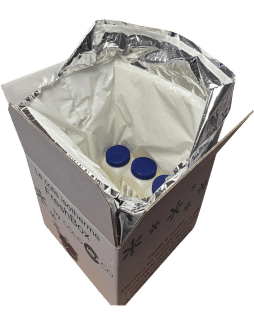
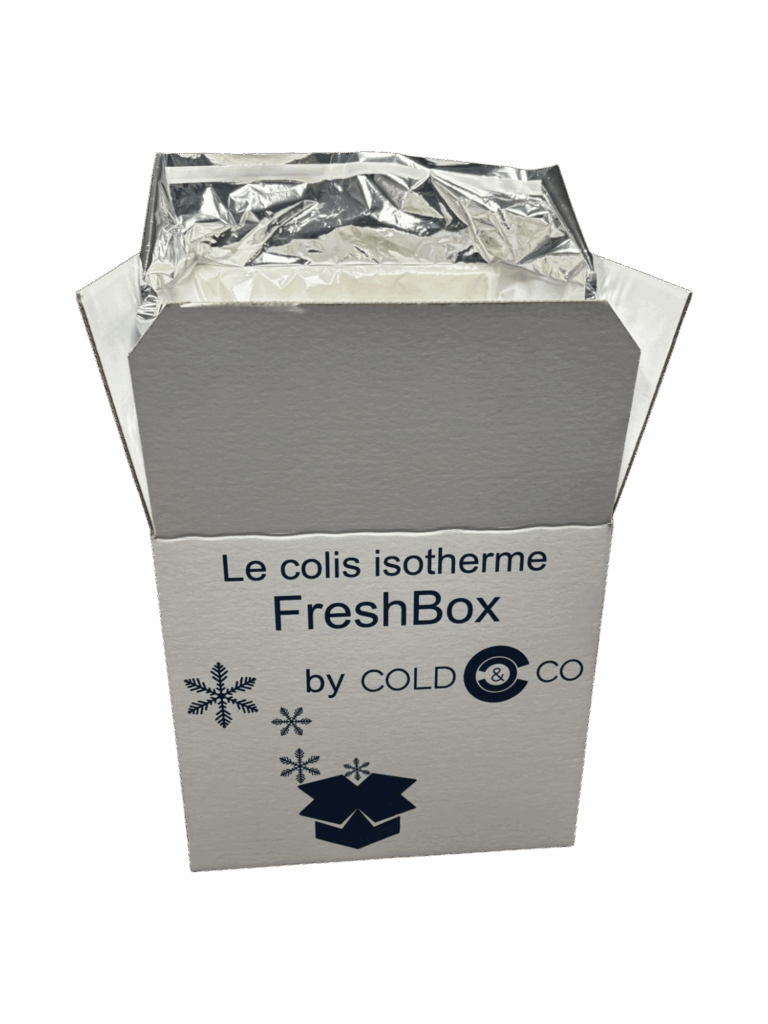
  • The FreshBox Plus, a compact and efficient isothermal packaging with an insulating thickness of 20 mm of foam
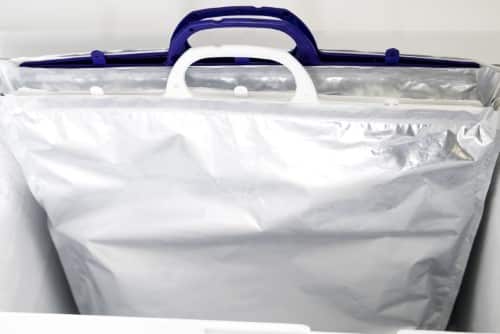
  • The CottonInsert, a flexible and recyclable textile insert, to be integrated into a standard logistics box (also existing in the form of an envelope).

A high-performance thermal barrier for fine chemistry

Our isothermal packaging FreshBoxPlus and CottonInsert are thermal protection solutions. Their role? Avoid thermal shocks related to cold, by maintaining the internal temperature of your packages in a secure area, even in case of temporary exposure to low external temperatures.

These solutions are relevant for the transport of non-refrigerated cold sensitive products, such as certain varnishes, glues, paints, inks or cosmetics.

Ecological alternative to boxes made of expanded polystyrene (EPS), a material increasingly banned from industrial logistics for environmental reasons, our solutions offer performances equal or even superior to those of polystyrene, while being more compact, recyclable and compliant with the CSR commitments of companies.

What isothermal packaging for fine chemistry ? Polystyrene vs alternatives COLD & CO

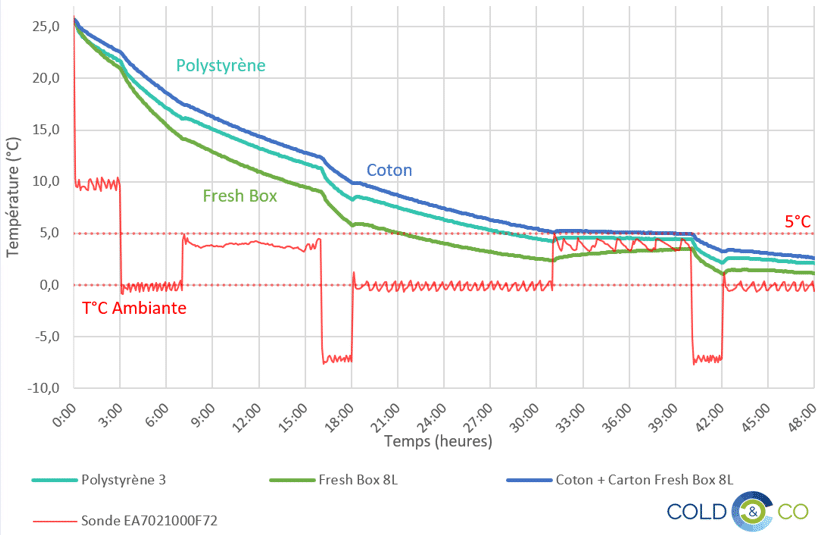
In order to evaluate the real effectiveness of our solutions, we conducted a comparative test between three types of insulated packaging used for the transport of temperature-sensitive products.

The classic solution :

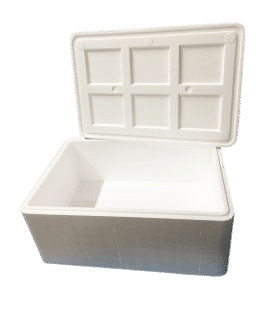
  • a box made of expanded polystyrene (EPS), a solution historically used in the sector,

The COLD & CO solutions :

  • the FreshBox Plus, our high-performance isothermal flexible packaging,
  • the CottonInsert, our insert in recycled textile fibers designed to fit inside your cardboard boxes.

Comparable performance, an isothermal packaging that stands out for fine chemistry

Under identical test conditions, the thermal performances of the three solutions are close. However, CottonInsert is distinguished by better cold resistance, demonstrating an ability to slow down heat transfer more effectively than conventional alternatives, including polystyrene.

A solution that can be duplicated in other industrial fields of fine chemistry

This use case is far from being unique. Our isothermal solutions are perfectly adapted to temperature-sensitive industrial products packaged in small containers:

  • Technical dyes and inks
  • Temperature-sensitive cosmetics and skincare
  • Specific glues and adhesives
  • Automotive varnishes or retouching products

Eco-responsible and efficient

Made from recycled and recyclable materials, the FreshBox Plus and CottonInsert insulated packaging are designed to combine thermal efficiency with environmental responsibility. Locally produced, they meet modern logistics requirements while reducing their carbon footprint.

Do you carry non-food temperature-sensitive products ?

Contact us to evaluate together the most suitable solution for your use !

Transport at controlled ambient temperature between +18°C and +25°C : a logistical challenge for medical devices

The thermal challenge +18°C to +25°C at the heart of medical logistics In the field of the transport of medical devices of in vitro diagnostics (IVD), some entities face a particular challenge: maintaining a strictly controlled temperature between 18°C and 25°C, regardless of the season. In both winter and summer, this requirement for thermal stability […]
Transport at controlled ambient temperature between +18°C and +25°C : a logistical challenge for medical devices Lire la suite »

Delhaize and home delivery of frozen foods

DELHAIZE tells the story of our cooler bag Our client ? Delhaize is the benchmark for Belgian supermarkets. The store chain places great importance on maintaining the temperature of its ambient, fresh and frozen products throughout the supply chain, from order preparation to the customer’s home. His needs ? An isothermal container that integrates with

Delhaize and home delivery of frozen foods Lire la suite »

A major player in food delivery adopts the passive cold chain with CarryTemp from COLD & CO

A refrigeration logistics revolution at the service of agility, economy and sustainability A French leader in home food delivery recently redesigned its fleet and delivery practices. Exit the refrigerated trucks, place to a more agile and economical solution: passive refrigeration with the isothermal and refrigerated CarryTemp containers from COLD & CO. 1. From a compartmentalized

A major player in food delivery adopts the passive cold chain with CarryTemp from COLD & CO Lire la suite »

A major food delivery company adopts the passive cold chain with CarryTemp from COLD & CO

A cold logistics revolution for agility, economy and sustainability A leading French home-delivery food service recently carried out an in-depth rethink of its fleet and delivery practices. Gone are the refrigerated trucks, replaced by a more agile and economical solution : passive refrigeration with COLD & CO’s CarryTemp isothermal and refrigerated containers. 1. From a

A major food delivery company adopts the passive cold chain with CarryTemp from COLD & CO Lire la suite »

Transport at controlled ambient temperatures between +18°C and +25°C: a logistical challenge for medical devices

The +18°C to +25°C thermal challenge at the heart of medical logistics When it comes to transporting in vitro diagnostic medical devices (IVDMDs), certain entities face a very specific challenge: maintaining a strictly controlled temperature between 18°C and 25°C, whatever the season. In winter as in summer, this requirement for thermal stability is crucial to

Transport at controlled ambient temperatures between +18°C and +25°C: a logistical challenge for medical devices Lire la suite »

A messenger RNA vaccine against COVID 19, what impact on the cold chain?

Since November 9, several laboratories have announced the development of a vaccine that is more than 90% effective. Pfizer-BioNtech laboratories present their first results obtained on a messenger RNA (mRNA) vaccine. What is the principle of this vaccine? What impact on its cold chain ? Historical vaccines with infectious agents Historically, the first vaccines were

A messenger RNA vaccine against COVID 19, what impact on the cold chain? Lire la suite »

Portage, collection, distribution : passive cold solutions for local communities

CCAS & communities : what if you chose isothermal equipment designed for your real constraints ? Meals delivered to elderly people, redistribution of unsold food, supply of school canteens or medico-social institutions : strict compliance with the cold chain is a regulatory necessity, but also a requirement for quality and public health. In a context

Portage, collection, distribution : passive cold solutions for local communities Lire la suite »
Papillomavirus: what you need to know about the vaccine and the vaccination campaign

While the French government has launched a general vaccination campaign (supported by the Institut National du Cancer) against HPV in French secondary schools, aimed at 5th graders, it is still estimated that almost 8 out of 10 people are exposed to Human Papilloma Virus (HPV) in the course of their lives. This high figure may

Papillomavirus: what you need to know about the vaccine and the vaccination campaign Lire la suite »